Rocks and Hard Places: reflections on belonging
I have long taken exception to a familiar refrain in rural Britain: that even after twenty, forty, or more years, one may still not be considered a native of a locality. The implication is clear enough. Belonging is granted by time served, lineage, and inheritance. For those who arrive later, the message is blunt: you do not yet belong, and perhaps never will. In some northern communities, incomers are even referred to as ‘the crop’: a transient population expected to take root briefly before failing to thrive and moving on within five years. Such language reveals an underlying scepticism toward those who choose, rather than inherit, their place. It is a quiet but persistent kind of exclusion and a form of snobbery, and I have often wondered who, exactly, gets to decide it.
For artists whose work is shaped by the landscape they live in, the question of belonging takes on another meaning. To be deeply influenced by a place is to pay sustained attention to it. It means looking across seasons, in changing light and weather, from different and sometimes unconventional angles. It is not the same as passing through and making a likeness. It is a slower, more exacting kind of seeing, one that gives the work depth and authenticity.
Some artists work materially with the land itself, such as ceramicists using local clay, but even when they do not, the landscape enters the work through close observation and repeated encounter. Barbara Hepworth and Ivon Hitchens come to mind as artists whose practices were inseparable from the environments they inhabited, though neither were born and raised there. Their work suggests not just observation, but a sustained and intimate dialogue with place. I do not think that kind of depth should belong only to farming families or those with generations of roots in the ground. It can be cultivated through attention.
This question has become increasingly important to me because my own work has been shaped more profoundly by place than I once expected. It is informed by two landscapes: South Africa, where I grew up, and Northumberland, where I now live in the North Pennines. In certain lights and terrains, the two feel unexpectedly alike. The open expanses, reedy grasslands, rock formations, tonal shifts, and severity of climate echo one another. That resonance is more than visual. It is affective. My ancestors came from this part of Northumberland, but my sense of belonging here does not rest on that alone. It comes from a convergence of past and present, from a recognition of forms, colours, and atmospheres that feel both remembered and immediate. That matters, and it is reflected in my work, especially in the themes of continuity and human endeavour that run through it.
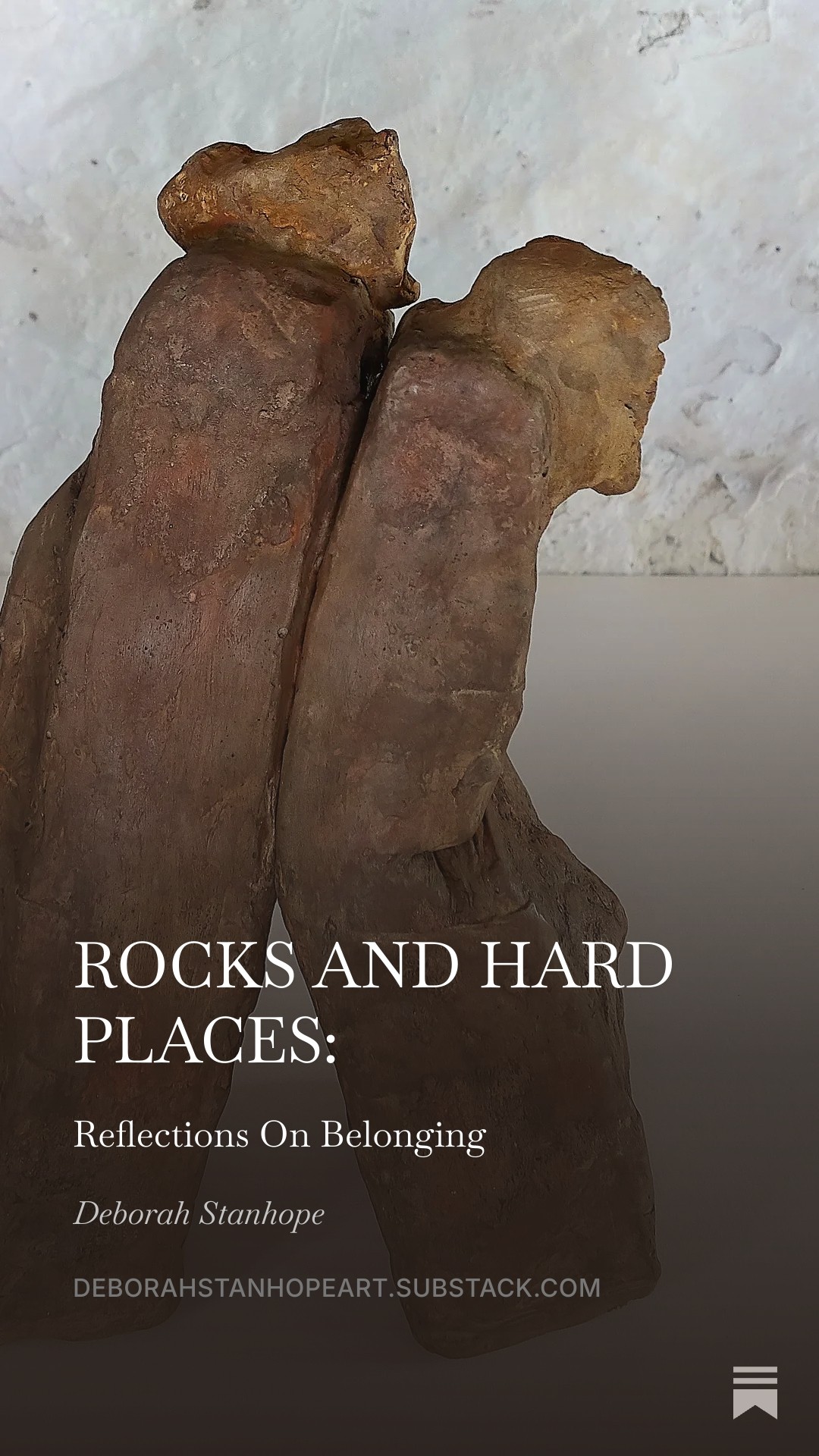
One preoccupation has been the stones and rock formations of this region: their natural shapes, their quarrying and dressing for roof tiles and buildings, the dry-stone walls that are so characteristic of the area, the way boulders lean into and onto one another to make structures that seem precarious yet endure. I notice how grass and peat slowly obscures their edges, how lichens alter their surfaces, how weather and season change colour and texture. I notice the stones pressed into tracks by boots and quad bikes, forming patterns and figures that almost resemble low reliefs.
These observations accumulate. So do the cycles of life around them: migratory birds returning each February, sheep and cattle sharing the fields, the curve of a cow’s hip, the weight of a sheep’s jaw, a tree bent by wind, eggs broken by stoats among reeds, small skeletons left in the grass, the annual grouse shoot. Colour, mass, form, texture, sound, even smell, all become part of an evolving vocabulary. That, to me, is what it means to belong to a landscape.
But this is not a romantic pastoral. Alongside it exists the managed, inhabited landscape: moorland burning, telegraph poles, plastic coloured pipes and manhole covers, galvanised gates, telecoms junction boxes, council bins, grit heaps. These are practical interventions, not intrusions that erase the natural world, but part of the same lived terrain.
Social belonging is different. I have never been especially drawn to collective identity or the reassurance of group affiliation, wherever I have lived. My practice, and in some ways my life, depend on a degree of distance. I do not feel any need to earn the status of native, and I value the freedom that comes with not trying to. It allows me to work and live authentically, without too much pressure from galleries, peers, trends, or the demands of visibility.
That is not to dismiss dialogue or criticism, both of which matter. But there is a difference between exchange and conformity. Social belonging often requires compromise, an alignment with shared expectations and values that can subtly shape, and sometimes constrain, artistic direction. The responsibilities it brings are real, but so are the costs. To belong to the land is different. It asks for attention, care, caution and reciprocity. It is less conditional, less performative, and perhaps more enduring.
Still, as D. W. Winnicott observed, “It is a joy to be hidden and a disaster not to be found.” Between visibility and obscurity, acceptance and autonomy, I find myself, as ever, between rocks and hard places.